
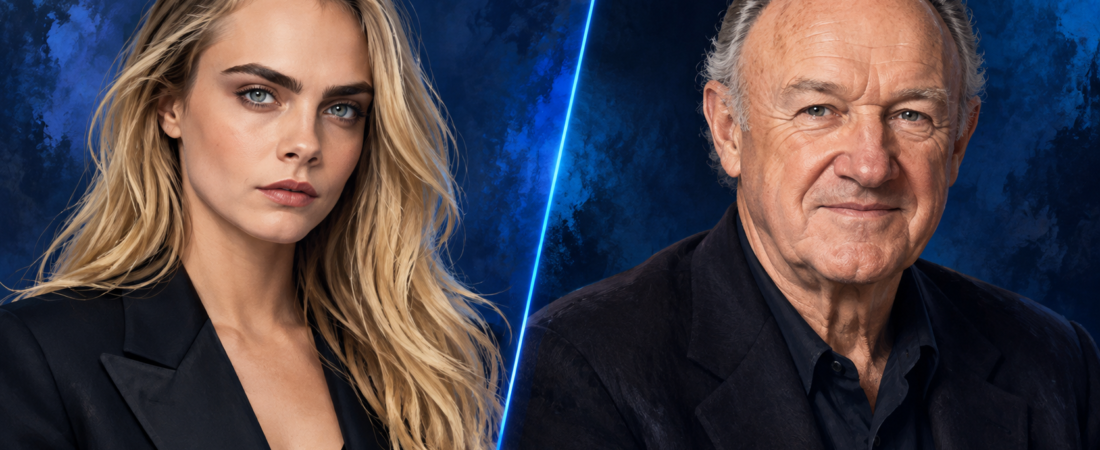
Cara Delevingne and Gene Hackman: Are They Related? The Verified Connection, Biographies & Career Comparison
Two recognizable names, two very different careers—and one surprising link through DC Comics. Here is what the public record actually supports, plus the lives and achievements behind the search.
 Photo source / licence (if image does not display)
 Photo source / licence (if image does not display)
Are Cara Delevingne and Gene Hackman connected?
No publicly documented family relationship, romance, friendship, or direct acting collaboration has been established between Cara Delevingne and Gene Hackman. The most meaningful connection visible in their film careers is that both portrayed characters associated with DC Comics. Delevingne played June Moone / Enchantress in Suicide Squad (2016). Hackman portrayed Lex Luthor in the Superman films beginning with the 1978 original. These were separate movies, eras, casts and continuities. Neither credited appearance is evidence that the two performers met or worked together.
The precise wording matters. A lack of public evidence does not prove that two people never crossed paths privately. What it does mean is that a responsible biography cannot invent a friendship, family tie or secret project simply because a search engine displays their names together. The useful answer is the one supported by published credits, trustworthy biographies and official film materials. [DC: Suicide Squad] [DC: Superman]
- Related? No established family relationship.
- Dated or married? No credible evidence of a romantic relationship.
- Co-stars? No known shared film or television credit.
- Shared screen universe? Both played DC-related characters, but in separate productions.
- Why compare them? Their journeys show two different routes to visibility in film and popular culture.
Cara Delevingne vs. Gene Hackman: Quick facts
This comparison distinguishes facts that can be supported by biographical records from financial guesses and information that changes with time. Ages are calculated as of October 28, 2026; Hackman’s age refers to his age when he died.
| Detail | Cara Delevingne | Gene Hackman |
|---|---|---|
| Full name | Cara Jocelyn Delevingne | Eugene Allen Hackman (often known as Gene) |
| Date of birth | August 12, 1992 | January 30, 1930 |
| Age | 34 in October 2026 | 95 at death in 2025 |
| Birthplace | London, England | San Bernardino, California, USA |
| Height | 5 ft 8 in (1.73 m), IMDb listing | 6 ft 1½ in (1.87 m), IMDb listing |
| Nationality | British | American |
| Primary work | Model, actor, singer | Actor, novelist |
| Well-known roles | Paper Towns, Suicide Squad, Carnival Row | The French Connection, Unforgiven, Superman |
| DC character | June Moone / Enchantress | Lex Luthor |
| Major screen award | Fashion awards; no Academy Award win | Two Academy Awards |
| Family | Parents Charles and Pandora; sisters Chloe and Poppy | Three children with first wife Faye Maltese |
| 2026 status | Active in entertainment; released debut album | Died in February 2025 |
Height figures above are database listings, not independent physical measurements. Personal financial estimates are examined separately rather than presented as verified assets. [IMDb: Delevingne] [IMDb: Hackman]
Why are Cara Delevingne and Gene Hackman searched together?
There is no verified public explanation for why this particular pairing appears in searches. It may look like the sort of query produced by celebrity relationship curiosity, a film-credit question or the desire to compare two famous people. None of those possibilities should be mistaken for a documented origin story. Search suggestions can reflect what people type; they are not certificates of kinship or proof of an undisclosed event.
Unlike two celebrities photographed attending the same premiere, Delevingne and Hackman have no well-established shared public moment to anchor a direct relationship article. Their professional histories instead offer an indirect cultural overlap. A reader might know Delevingne from a modern DC ensemble movie and remember Hackman as the original big-screen Lex Luthor opposite Christopher Reeve. The link is real at the level of source material and screen genre, but it stops there.
That distinction also explains why comparison is more informative than gossip. One was initially recognized for runway fashion before branching into film, stage and music. The other spent years becoming a working actor before emerging as a defining figure in American cinema. Looking at their decisions, milestones and filmography answers far more about the individuals than an unsupported claim that they belonged to the same social circle.
Who is Cara Delevingne? Early life, family and education
Cara Jocelyn Delevingne was born on August 12, 1992, in London, England. She grew up in a family with prominent social and professional connections, but celebrity ancestry alone does not explain her later career. Her father, Charles Hamar Delevingne, worked in property development, and her mother, Pandora Stevens Delevingne, has been described in major biographical profiles as a former social figure and personal shopper. Her older sisters, Chloe and Poppy, are frequently mentioned in coverage of the family; Poppy has also worked as a model and actress. [IMDb biography]
She attended Bedales School in Hampshire and has discussed difficulties she experienced while growing up, including learning challenges and mental health concerns. The public interviews in which she talks about those experiences belong to her own story and should not be converted into sensational descriptions. They help explain the contrast between the glamorous image projected by a major fashion campaign and the more complicated private work of developing a sense of self.
Before adult modeling assignments became a defining part of her public identity, Delevingne appeared in fashion imagery at a young age. She signed with Storm Model Management as a teenager. The step mattered because modeling could have remained one of several interests; instead it became the career that put her in front of global fashion audiences. Runways, editorial spreads and advertising campaigns required very different skills from the film acting she would later pursue.
 Photo source / licence (if image does not display)
Modeling career: From runways to international recognition
Delevingne gained significant visibility through luxury fashion and high-profile campaigns, notably with Burberry, and walked for designers and houses including Chanel and other major international labels. Her face, eyebrows and expressive runway presence became unusually recognizable to audiences who might not normally follow fashion-week casting. In the early 2010s, her style was reproduced across magazines, street-style photography and beauty campaigns.
Industry recognition helped consolidate her status. She won Model of the Year at the British Fashion Awards in 2012 and 2014, achievements often cited in profiles of the decade’s biggest models. Awards in fashion should not be conflated with movie awards: they recognize work and influence in a separate industry. That difference becomes important when comparing her record with an actor whose signature accolades came from the Academy of Motion Picture Arts and Sciences.
The broader reason Delevingne became culturally recognizable was not simply that she booked prestigious shows. She emerged at a moment when fashion personalities could build cross-platform visibility through photographs, magazines, internet communities and their own public voice. She was discussed as a personality as well as a model. That visibility opened doors, yet it also placed her professional decisions under scrutiny from audiences whose first impression had been a fashion image rather than a performance.
 Photo source / licence (if image does not display)
Transition from modeling to acting
Delevingne’s early film appearance came in Joe Wright’s adaptation of Anna Karenina (2012). Her larger breakthrough for mainstream film audiences was Paper Towns (2015), in which she played Margo Roth Spiegelman, the enigmatic character central to the adaptation of John Green’s young-adult novel. It gave viewers a very different reference point from a runway photograph and introduced her to a broader American moviegoing audience. [Hulu official biography]
In Suicide Squad (2016), she played June Moone and the supernatural figure Enchantress. The production offered the scale of a franchise-based ensemble and connected her to a major comic-book property. In Valerian and the City of a Thousand Planets (2017), she appeared opposite Dane DeHaan as Laureline in a visual-effects-driven science-fiction adventure. These movies put her in films whose publicity and expectations were much larger than an independent feature.
Her later credits demonstrated range rather than a single continuous rise toward blockbusters. She appeared in the fantasy series Carnival Row, joined the second season of Only Murders in the Building, and appeared in American Horror Story: Delicate. Film and television allowed her to experiment with fantasy, comedy, mystery and horror-related storytelling. That range does not mean every project met the same critical or commercial response; it means her screen career cannot be reduced to one comic-book role.
It is worth distinguishing public recognition from a conventional acting résumé. Delevingne did not spend decades in theater repertory before reaching major film projects. She entered acting with an established fashion profile, a path that creates opportunities and skepticism at the same time. Audience expectations of a famous model can be unusually rigid; the challenge is to establish a believable character independent of the face people have seen in campaigns.
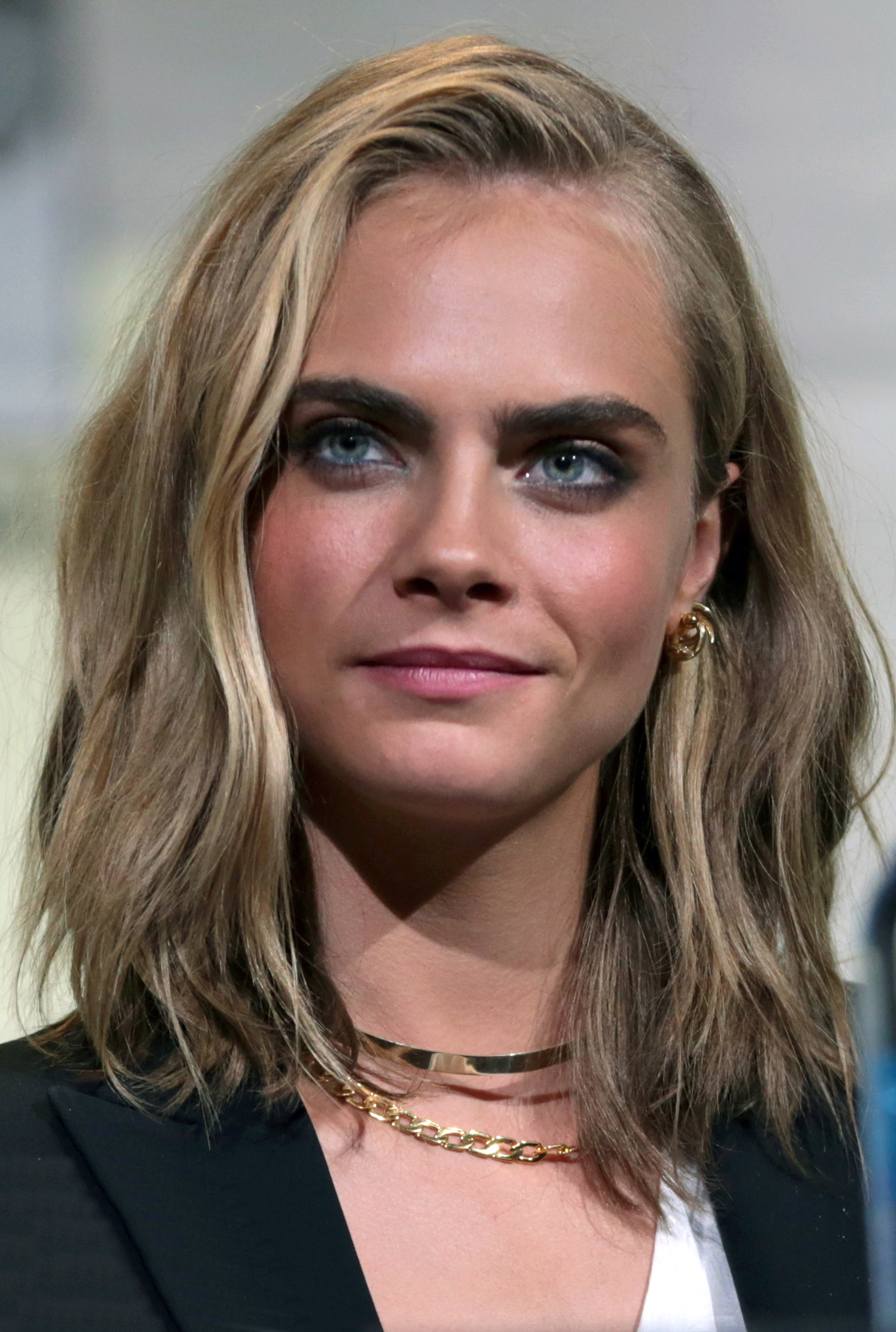 Photo source / licence (if image does not display)
Stage work: Playing Sally Bowles in Cabaret
One especially important development occurred in 2024, when Delevingne took on Sally Bowles in the West End production of Cabaret in London. Announced in February of that year, the casting placed her alongside Luke Treadaway in a production that demanded live acting, singing, sustained character work and an evening-long performance. Her scheduled run began in March and continued into early June. [WhatsOnStage casting report]
The significance of a stage role is not merely that it adds another line to a biography. A live musical requires a performer to hold attention without the close-ups, editing and reshoots available to a film actor. Sally Bowles is also a demanding role because it balances charisma, vulnerability, theatrical performance and the political atmosphere around the character. For someone known first as a model, the casting offered a new arena in which audiences could evaluate her work.
It would be misleading to describe the appearance as proof of any link to Gene Hackman. He did not share that production. Its relevance to this article is biographical: it demonstrates how Delevingne sought new ways of performing after achieving fame in a very different profession. Her increasingly varied career forms an interesting contrast with Hackman’s route through acting schools, stage work and character parts.
Cara Delevingne’s music career and the 2026 album Not Normal
Music is more than a side note in her 2026 biography. Delevingne has said in interviews that she played instruments while young and dreamed of creating songs, even as modeling and acting took priority professionally. In May 2026, she released the singles “I Forgot” and “Out of My Head” and discussed the personal experiences that informed the project. She also performed live, turning a longstanding creative ambition into a public recording career. [Vogue, May 2026]
Her debut full-length album, Not Normal, was released on September 25, 2026 through Warner Records, with 12 songs listed by Apple Music. Its release is a verifiable milestone—not a projected future launch—and makes outdated descriptions of Delevingne solely as a model and actress incomplete. The work explores intensely personal themes, and contemporary interviews explain why writing and recording provided a different creative outlet than fashion or acting. [Apple Music album listing]
The album also gives her professional timeline an unusual shape. International runway fame preceded major screen parts, a West End musical followed, and original music emerged publicly in her thirties. That sequence is different from the usual expectation that a performer begins with music and then moves into acting. It illustrates the value of treating her career as a series of evolving disciplines rather than as a single job title that stayed fixed after her first fame.
Public advocacy and creative identity
Delevingne has used interviews and documentary work to discuss identity, relationships, self-expression and aspects of personal wellbeing. Her Hulu documentary series Planet Sex is one example of a project in which the subject matter was not simply a fictional character. As with any public figure, these discussions should be presented through her own published statements rather than speculative labels attached by outside writers. [Hulu press biography]
When readers ask why she is famous, there is no one-word answer that captures her current profile. The practical summary is that she became famous through modeling, built an acting portfolio across film and television, performed on the London stage, and released an album in 2026. Her biography is better understood as a continuing professional story than as a list of rumored connections to other celebrities.
Who was Gene Hackman? Early life, military service and acting breakthrough
Gene Hackman was born on January 30, 1930, in San Bernardino, California. His upbringing differed sharply from Delevingne’s London childhood. His family moved during his early years, eventually settling in Danville, Illinois. Biographical accounts describe a difficult family environment, and his father left when Hackman was young. Before movie fame, he was not presented to the public as a celebrity’s child or an established fashion personality; his later recognition grew out of long professional effort. [Associated Press obituary]
Hackman joined the U.S. Marine Corps at 16 after misstating his age, a detail repeated in major biographies. He worked as a radio operator during his service. The military years were an early chapter of a life that would later take him through journalism studies, informal jobs and eventually performance training. They also provide an instructive contrast with the straightforward idea that a successful actor was recognized instantly as talented by an industry gatekeeper.
 Photo source / licence (if image does not display)
Years of struggle and professional training
After military service, Hackman spent time in New York and pursued classes and jobs while deciding what kind of career to build. He studied acting at the Pasadena Playhouse in California. Accounts of those early years emphasize that a lasting career in the arts was neither secure nor obvious. He had to build practical experience, take work that supported him and continue pursuing opportunities despite rejection.
He became associated with other aspiring actors in an environment where formal training and persistence mattered. By the 1960s, he was appearing on stage and television and moving toward more substantial film parts. For a future Oscar winner, this was a relatively slow ascent. The details matter because they help explain why his performances were often described as grounded: he did not arrive on screen as an immediate glamour star and was frequently cast for the convincing reality he brought to flawed, complicated characters.
The breakthrough most commonly associated with his early film career came with Bonnie and Clyde (1967), for which he received an Academy Award nomination for supporting actor. That recognition did not transform every role thereafter into a lead. Rather, it showed the industry that he could make a strong impression within an ensemble and helped prepare the way for the performance that would define his breakthrough as a star.
The French Connection and his first Academy Award
In William Friedkin’s The French Connection (1971), Hackman played New York detective Jimmy “Popeye” Doyle. The role was aggressive, morally complicated and dramatically compelling. The movie’s gritty style and memorable pursuit sequences helped it become a landmark of American crime cinema. Hackman won the Academy Award for Best Actor at the ceremony in 1972, as confirmed by the Academy’s official historical record. [The Academy, 1972]
The performance is significant because it was not built around the easy appeal of an idealized hero. Popeye Doyle’s judgment and behavior create discomfort, yet the character commands attention. Hackman’s ability to make difficult characters watchable became one of his greatest strengths. Rather than always asking audiences to admire the person on screen, his work invited them to pay attention to decisions, contradictions and consequences.
Winning an Oscar is a major marker in any actor’s career, but it did not confine Hackman to one style of movie. Over the following years he moved among crime dramas, thrillers, comedies and large studio productions. That flexibility helped him avoid being remembered for one successful role alone. His filmography is broad enough that different generations of viewers associate him with different performances.
Memorable 1970s roles: The Conversation and Superman
Francis Ford Coppola’s The Conversation (1974) gave Hackman one of his most celebrated introspective roles, playing surveillance specialist Harry Caul. Compared with the restless force of Popeye Doyle, Caul is guarded, inward-looking and intensely concerned about the consequences of information. The movie explores privacy, uncertainty and conscience, themes that remain relevant in a technologically saturated culture.
Hackman also proved capable of a very different kind of screen presence. In Richard Donner’s Superman (1978), he played Lex Luthor, the calculating enemy of Christopher Reeve’s Superman. The movie balanced action, spectacle, romance and humor. Hackman’s characterization of Luthor added wit and theatricality to a villain whose confidence is as important as his schemes. Official DC movie pages confirm his participation in the 1978 film and in subsequent installments. [DC: Superman]
Those roles illustrate how wide his range was. Harry Caul’s anxiety is almost the opposite of Lex Luthor’s showmanship. Both are instantly recognizable Hackman performances, but they demand different energies. That is an important part of understanding his reputation: his best work did not depend on a single public persona or a single genre. The camera could catch him at his most restrained or his most flamboyant.
 Photo source / licence (if image does not display)
1980s films and the road to Unforgiven
In the 1980s, Hackman remained a major presence in American film. His credits included Hoosiers (1986), a basketball drama in which his performance as a coach became one of his most accessible and enduring roles, and Mississippi Burning (1988), for which he received another Academy Award nomination. He also returned to the Lex Luthor character in Superman II (1980) and Superman IV: The Quest for Peace (1987).
Then came Clint Eastwood’s Unforgiven (1992). Hackman played Little Bill Daggett, a sheriff whose ideas about order and violence are inseparable from his own use of power. The role won him the Academy Award for Best Supporting Actor at the 1993 ceremony, his second Oscar. The Academy’s website identifies the film and category, providing a stronger source than lists that casually repeat total award counts without specifying the wins. [The Academy, 1993]
Unforgiven also helped demonstrate why a long career can deepen an actor’s impact. Hackman brought decades of professional experience to a film questioning the romantic mythology of the American Western. Little Bill can seem ordinary in one scene and frightening in the next. The power of the performance comes from that unpredictability and from Hackman’s refusal to simplify the character into a cartoon villain.
Later movies, retirement and writing
Hackman’s 1990s and early-2000s work included Crimson Tide, Enemy of the State, The Royal Tenenbaums, Heist and other films. Each offered a different opportunity to use his authority, tension, comic instincts or experience. In The Royal Tenenbaums, for example, his performance helped create a very different sort of family patriarch than the police officers, commanders and villains that audiences knew from earlier roles.
By the middle of the 2000s, Hackman had largely stepped away from film acting. His last major acting feature was Welcome to Mooseport (2004). Retirement from film did not mean the disappearance of creative interests. He pursued painting and wrote novels, including historical and adventure fiction, sometimes collaborating with other writers. This later chapter is easy to overlook when a short profile treats his career as though it ended with his final movie credit.
Hackman’s decision to leave regular movie work contrasts with Delevingne’s expansion into new media in 2026. The comparison is not a contest between younger and older forms of celebrity. It shows that artistic careers can be built in opposite directions: one performer can spend decades refining a central craft and later withdraw, while another can continue trying new creative forms after establishing international fame.
 Photo source / licence (if image does not display)
Gene Hackman’s death in 2025: What authorities established
Gene Hackman died in February 2025 at age 95. He and his wife, pianist Betsy Arakawa, were found at their Santa Fe, New Mexico, home on February 26, 2025. After an investigation, New Mexico authorities said Hackman had died of heart disease, with advanced Alzheimer’s disease as a contributing condition; evidence from his pacemaker suggested approximately February 18 as the date of death. Authorities said Arakawa had died earlier from hantavirus pulmonary syndrome. Both deaths were ruled natural. [Associated Press, March 2025]
The exact date of death is often given as an estimate because investigators reconstructed the timeline after the bodies were discovered. For that reason, an article should distinguish the date the deaths were discovered, February 26, from the likely date of Hackman’s death, around February 18. It is also important not to imply that the cause of his death was the same illness that killed his wife. Official findings separated the causes.
There was substantial public attention when the discovery became known, and early reports described an investigation without a finalized cause. Those first reports are not a substitute for the later medical findings. Accurate biography writing should use the completed findings where available, avoid repeating superseded speculation and respect that the story concerns the deaths of real people rather than an entertainment mystery.
His legacy remains rooted in an exceptionally varied filmography, performances that resisted easy hero-villain stereotypes and two Academy Award wins. Fans also remember the stories, paintings and quieter life he pursued away from film sets. Hackman’s death closes the biographical timeline, but his work continues to be available for discussion and rediscovery by new generations of viewers.
The real DC Comics connection: Enchantress vs. Lex Luthor
Of all possible comparisons, DC Comics provides the cleanest verifiable intersection between the careers. This is an indirect connection through source material, not a personal or on-set relationship. Delevingne’s performance as Enchantress appeared in Suicide Squad, released in 2016. Hackman’s Lex Luthor debuted in Superman, released in 1978, followed by appearances in later films from that cycle. Both titles have official DC movie pages with cast information. [Official DC cast] [Superman IV]
Cara: Enchantress
June Moone becomes entangled with a powerful supernatural entity. The character’s place in the story relies on fantasy, transformations and the unstable balance between identity and dangerous power.
Gene: Lex Luthor
Lex Luthor is a scheming human adversary to Superman. Hackman’s version combines sharp dialogue, theatrical self-confidence and grand plans rather than supernatural powers.
Calling both performers “DC actors” is reasonable in the broad sense that they appeared in DC-related screen adaptations. Calling them co-stars would be wrong. Neither movie’s official cast list places both names in one production. Their roles also do not belong to one shared acting era, and their characters never met through these performances. A viewer can compare the archetypes, but the comparison is editorial, not evidence of an actual crossover.
The distinction between villain and antihero is also worth noting. Lex Luthor is usually introduced as Superman’s antagonist; Enchantress’s portrayal in Suicide Squad turns on a human host and a supernatural threat. Their narrative functions are not identical, and the productions differ substantially in tone, period and filmmaking technology. That makes the pair an interesting example of how comic-book cinema changed across decades, rather than a story about a hidden relationship between two performers.
Hackman’s character existed in a style of superhero filmmaking shaped by pre-digital blockbuster conventions. Delevingne’s character appeared in a contemporary effects-heavy ensemble universe. By comparing them, a reader can see how the roles of supporting villains, fantasy powers and recognizable celebrities evolved, without inventing meetings, family links or rumors unsupported by primary records.
Career timeline: Important milestones across two generations
A timeline helps answer another search-intent question: could their careers plausibly have overlapped in a specific production? Hackman’s best-known movie period began decades before Delevingne’s acting debut, and his withdrawal from acting preceded her first major film work. They were both public figures for part of the same broad historical period, but that alone is not a collaboration.
Gene Hackman is born in San Bernardino, California.
Hackman trains, works on stage and television, and gains a major film breakthrough with Bonnie and Clyde (1967).
His performance in The French Connection wins the Academy Award for Best Actor.
Hackman plays Lex Luthor in Superman, his first major DC character appearance.
Cara Delevingne is born in London; Unforgiven arrives in cinemas and brings Hackman his second Oscar the following year.
Welcome to Mooseport is Hackman’s final major acting feature before retirement.
Delevingne earns major fashion recognition and makes an early film appearance in Anna Karenina.
Delevingne stars in Paper Towns, Suicide Squad and Valerian and the City of a Thousand Planets.
Delevingne plays Sally Bowles in London’s Cabaret.
Hackman dies at 95 in Santa Fe, New Mexico.
Delevingne releases her debut album Not Normal on September 25.
Spouses, partners, parents and children: What is public?
Cara Delevingne’s family and relationship history
Delevingne’s parents are Charles Hamar Delevingne and Pandora Stevens Delevingne. She has older sisters Chloe and Poppy. Public biographies also identify other relatives, but the existence of a prominent family background is not evidence of a relationship with Hackman. Readers asking whether the two are cousins or otherwise related need a documented connection between their family trees; none has been established in reputable biographical sources. [IMDb]
Her love life has been discussed in celebrity coverage, including previous relationships. As of 2026, Delevingne has publicly discussed her relationship with British musician Minke. In an August 2026 interview with Elle, she referred to her partner of four years while discussing songs from her album. This is substantially stronger evidence than an anonymous “dating rumor” page because the individual herself is the source. A person’s relationship status can change, so dated sources matter. [Elle, August 2026]
Standard biographical listings do not identify a spouse or children for Delevingne. That should not be used as an invitation to speculate about future family plans. The relevant answer for this combined keyword remains simple: none of the reputable sources establishing her family or publicly discussed relationships identifies Gene Hackman as a relative or romantic partner.
Gene Hackman’s marriages and children
Hackman was married twice. He married Faye Maltese in 1956; they had three children, Christopher, Elizabeth and Leslie, and divorced in the 1980s. He later married Betsy Arakawa, a classical pianist, in 1991. The couple lived for many years in New Mexico, away from the constant publicity associated with Hollywood premieres. Major obituaries and biographies consistently describe this basic family history. [Associated Press obituary]
Arakawa died in February 2025, days before Hackman, according to the medical investigation released the following month. Their home and personal circumstances received extensive press attention after the discovery of their deaths. A respectful account should stick to established facts rather than turn surviving family members into targets for speculation about private conversations, motives or assets.
Hackman’s family history does not contain an established link to the Delevingne family. The names of his spouses and children also demonstrate why conflating two unrelated celebrity biographies is misleading: they refer to actual people whose identities can be verified. A search result is not enough to justify building a new family-tree branch between two famous individuals.
Cara Delevingne and Gene Hackman net worth: What can be verified?
Readers often encounter large celebrity net-worth numbers, but these figures deserve a warning. A person’s net worth is the value of assets minus liabilities. Press coverage of an endorsement contract, a film salary, a family company, a property or an estate is not the same thing. Neither person’s complete balance sheet is publicly available through the sources used for this article, so a precise personal net-worth figure cannot be independently certified here.
Websites frequently publish estimates for Cara Delevingne based on modeling, entertainment work, brand partnerships and commercial activities. Such numbers may differ significantly between outlets and years. Income from a successful career does not disclose taxes, expenses, ownership interests, borrowing or private investments. Unless a number is connected to verifiable financial documents, presenting it as an exact 2026 value would create false precision.
For Gene Hackman, one popular estimate cited by Biography attributes a figure of about $80 million to Celebrity Net Worth around the time of his death. This is a third-party estimate, not an audited estate valuation or verified probate total. The existence of a will, property or reported estate proceedings does not by itself prove the same amount. [Biography.com, estimate identified]
An estimated wealth figure is not a confirmed bank balance. A film’s box-office receipts are not an actor’s personal earnings; an album’s release does not reveal an artist’s current assets; and the gross value of an estate is not automatically what heirs receive. This article does not rank the two by wealth because the evidence would not support a reliable like-for-like comparison.
Hackman may be associated with an estate because he died in 2025, while Delevingne is actively earning and creating as of 2026. Those circumstances involve different financial concepts. Comparing them on an arbitrary “who is richer” scale would add little to the reader’s understanding and could imply knowledge that no published record establishes. Their documented achievements offer much stronger material for comparison.
Awards and achievements: Fashion influence versus film legacy
Delevingne’s awards and honors primarily reflect her early position in fashion and the visibility of her work across entertainment. Her Model of the Year awards in 2012 and 2014 mark an influential period of her runway career. Later she expanded into film, television, musical theater and recording. Counting only film awards would miss why she became a celebrity in the first place, while treating her fashion achievements as equivalent to Academy Awards would be an inaccurate comparison of two award systems.
Hackman received two Academy Awards: Best Actor for The French Connection and Best Supporting Actor for Unforgiven. He also received other Oscar nominations, including for Bonnie and Clyde, I Never Sang for My Father and Mississippi Burning. The official Academy database is the appropriate source for categories and award years. His influence is frequently described through performance style, longevity and the memorable characters he brought to life.
Both were adaptable, but the stakes and methods varied. Delevingne’s move from fashion to acting and then music required repeatedly establishing herself in fields where she was not originally known. Hackman’s adaptability usually meant moving between different roles inside one mature acting career. The shared theme is reinvention, not an identical creative trajectory or evidence of an interpersonal connection.
Claim-by-claim evidence: What is confirmed and what is not?
| Claim or question | Assessment | Best evidence |
|---|---|---|
| Both played DC characters | Confirmed | DC’s official Superman and Suicide Squad cast pages. |
| They were relatives | Not established | Standard family biographies identify separate families and no connecting relationship. |
| They dated or married | Not established | Credible relationship histories do not support this claim. |
| They appeared in the same film | No shared credit found | Available published filmographies and official movie cast listings. |
| Hackman won two Oscars | Confirmed | Academy Awards records for 1972 and 1993. |
| Hackman died in February 2025 | Confirmed | Medical investigation reported by Associated Press. |
| Delevingne released a 2026 album | Confirmed | September 25, 2026 Apple Music / Warner Records album listing. |
| Exact current personal net worth | Not independently verified | Celebrity wealth estimates are not audited balance sheets. |
Editorial note: A claim may be “not established” without being impossible. This table describes the accessible public record reviewed for the article, not a guarantee about every private interaction that may ever have occurred. That distinction is particularly important in combined celebrity-search topics, where mere name proximity can be misinterpreted as evidence.
What their careers reveal about changing fame
The distance between their generations is striking. Hackman arrived in film through military service, acting study, stage experience and a long climb toward prominent screen roles. His public image was grounded in the work of playing characters, rather than in a parallel life as a social media or fashion personality. He became famous in a media environment dominated by cinema, newspapers, television interviews and film criticism.
Delevingne became internationally recognizable in fashion at a time when a photograph could circulate instantly across multiple platforms. Her public identity preceded her best-known acting projects, and audiences were invited to follow her from campaign to runway to movie to stage to album. Those shifts reveal how the contemporary definition of a performer has widened, though they do not guarantee success in every artistic field.
The comparison should therefore not flatten the difference between building a career inside a profession and moving among several professions. One way to admire Hackman’s work is to study how he could make a character memorable without seeking to look glamorous. One way to understand Delevingne’s career is to follow how she translated visibility from one creative environment into opportunities and challenges in another.
They also demonstrate different relationships to fame. Hackman chose a relatively quiet retirement and pursued writing and other interests. Delevingne continued to experiment publicly with new modes of self-expression in 2026. Neither approach is inherently superior. What matters for a well-researched biography is describing these choices through documented career milestones, not connecting the individuals through stories that lack evidence.
For readers arriving from a search query that appears to promise a surprising secret, the better discovery may be that the supposed connection is limited, while the careers themselves are substantial. Delevingne’s success began on the runway but no longer ends there. Hackman’s lasting influence is preserved through a filmography that includes flawed detectives, uncertain surveillance experts, commanding authority figures and memorable villains. Both can be discussed accurately without pretending their lives were intertwined.
Frequently asked questions
Are Cara Delevingne and Gene Hackman related?
No family relationship is established in credible public biographies. Their names may be compared online, but a combined search phrase is not evidence of kinship.
Did Cara Delevingne and Gene Hackman ever work together?
No known film or television credit lists them as co-stars or collaborators. Their acting careers reached prominence in separate periods.
What is their actual DC Comics connection?
Delevingne portrayed June Moone / Enchantress in Suicide Squad (2016). Hackman portrayed Lex Luthor in the Superman film series, beginning in 1978.
Did they ever appear in the same Superman movie?
No. Delevingne did not appear in Hackman’s Superman films. Her DC-related role was in Suicide Squad.
How old is Cara Delevingne in 2026?
She was born on August 12, 1992, so she is 34 as of October 28, 2026.
How old was Gene Hackman when he died?
He was 95. He was born on January 30, 1930, and authorities estimated his death occurred around February 18, 2025.
How tall are Cara Delevingne and Gene Hackman?
IMDb lists Delevingne at 5 ft 8 in (1.73 m) and Hackman at 6 ft 1½ in (1.87 m). Those are database-listed heights.
Who are Cara Delevingne’s parents and siblings?
Her parents are Charles Hamar Delevingne and Pandora Stevens Delevingne; her older sisters include Chloe and Poppy Delevingne.
Who was Gene Hackman’s wife?
He was married first to Faye Maltese and later to pianist Betsy Arakawa. Arakawa died in February 2025, before Hackman.
How many children did Gene Hackman have?
He had three children with Faye Maltese: Christopher, Elizabeth and Leslie.
Does Cara Delevingne have children?
Public biographical listings reviewed for this article do not identify any children for Delevingne.
Who is Cara Delevingne’s partner in 2026?
Delevingne publicly discussed her relationship with musician Minke in an August 2026 interview with Elle. Relationship details should always be understood as time-specific.
What is Cara Delevingne’s 2026 album?
Her debut studio album Not Normal was released on September 25, 2026, with 12 tracks listed on Apple Music.
How many Oscars did Gene Hackman win?
Two: Best Actor for The French Connection and Best Supporting Actor for Unforgiven.
What was Gene Hackman’s cause of death?
Authorities attributed his death to heart disease, with advanced Alzheimer’s disease as a contributing condition. His wife’s death had a different cause: hantavirus pulmonary syndrome. Both were ruled natural.
Is Gene Hackman’s reported $80 million net worth confirmed?
No. It is a widely cited third-party estimate, not an independently audited valuation of his total assets or estate.
The connection is indirect; the careers are real
Cara Delevingne and Gene Hackman were both recognizable screen performers who portrayed DC Comics characters, but the public record does not establish a family tie, romance or shared acting project. The accurate story is not a hidden celebrity relationship. It is a comparison between a British model-turned-actor-and-musician and an American cinema legend whose career spanned decades and earned two Oscars.
Delevingne’s 2026 album adds a timely chapter to her evolving biography. Hackman’s death in February 2025 makes his career and legacy a completed historical story. Keeping those facts separate, checking each claim against reliable sources and avoiding invented connections produces a more useful article than a sensational headline could.
Sources and photographic credits
Research checked October 28, 2026. Sources below support the factual claims. Photograph credits are also provided directly under each image; the photo links lead to the corresponding Commons file and licensing information.
- DC — Suicide Squad (2016), official film and cast
- DC — Superman (1978), official film and cast
- DC — Superman II (1980) and Superman IV (1987)
- IMDb — Cara Delevingne biography, family, date of birth and listed height
- IMDb — Gene Hackman biography and listed height
- Hulu Press — Cara Delevingne professional biography
- WhatsOnStage — Cabaret West End casting announcement, February 2024
- Vogue — Delevingne discusses her 2026 music
- Apple Music — Not Normal, release and tracklist, September 2026
- Elle — August 2026 interview on music and relationship
- Academy Awards — 1972 winner listing and 1993 winner listing
- Associated Press — Gene Hackman career obituary, February 2025
- Associated Press — Medical investigation and causes of death, March 2025
- Biography — Family and clearly attributed net-worth estimate
Image licence directory
- Cara Delevingne at a Diane von Fürstenberg runway show in 2013 — Christopher Macsurak, CC BY 2.0.
- Gene Hackman in a 1972 publicity portrait — Publicity photo / Wikimedia Commons, Public domain in the United States.
- Cara Delevingne at a London Fashion Week reception in 2014 — U.S. Embassy London, Public domain (Commons listing).
- Cara Delevingne on the runway during London Fashion Week in 2014 — Walterlan Papetti, CC BY-SA 4.0.
- A young Gene Hackman during his service with the U.S. Marine Corps — U.S. Marine Corps, Public domain (Commons listing).
- Cara Delevingne at San Diego Comic-Con in 2016 — Gage Skidmore, CC BY-SA 3.0.
- Gene Hackman photographed at the White House in 1987 — White House Photographic Collection / U.S. National Archives, Public domain, U.S. federal government work.
- Gene Hackman at an Albuquerque book signing in 2008 — Bill Chodubski (serreel), Dedicated to the public domain.


Image reuse: please retain each photo’s credit and link to its licence. If your CMS or hosting blocks Wikimedia image delivery, upload permitted image files to your own WordPress Media Library and replace the image URLs. Public-domain status can vary by jurisdiction. Share-alike licence terms may apply to modifications.