
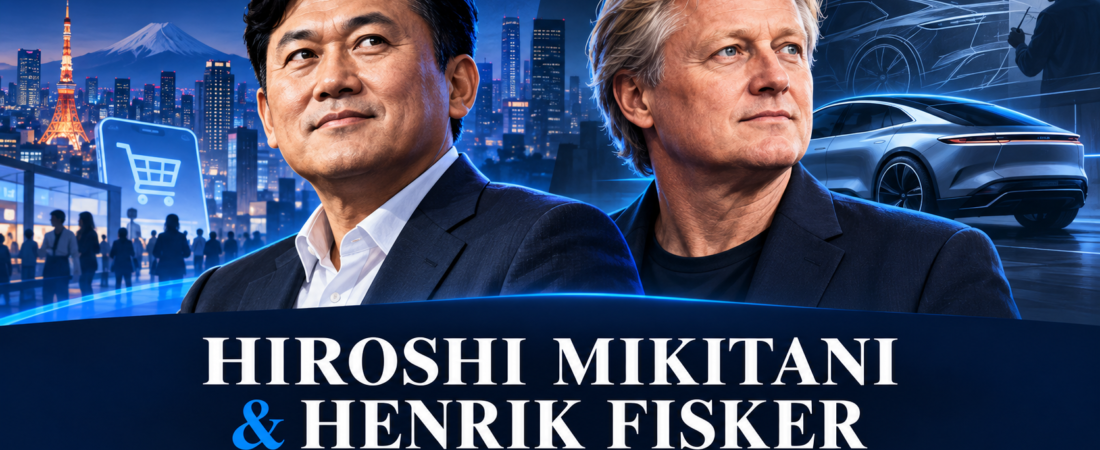
ROOFLEOO · BUSINESS & BIOGRAPHY
Hiroshi Mikitani and Henrik Fisker: Careers, Companies & Lessons
Two founders. Different industries. A closer look at the businesses behind their reputations—and the limits of comparing them.
Hiroshi Mikitani founded Rakuten, the Japanese group spanning online commerce, financial services and mobile communications. Henrik Fisker is a Danish automotive designer associated with the BMW Z8 and later with Fisker Automotive and Fisker Inc. The sources reviewed for this article do not establish a joint venture or business partnership between them. Their careers offer a comparison, not a documented shared business story.
Searching for Hiroshi Mikitani and Henrik Fisker brings together two people whose names are closely identified with the companies they created. That similarity can hide more than it reveals. A marketplace founder has to attract merchants and shoppers. A vehicle founder has to deliver a physical product, finance its production and support it long after the sale. Both need trust, but they earn and maintain it through different operating systems.
This guide separates biography from business analysis. It follows the important dates, distinguishes the two Fisker companies, and explains why neither a famous design nor a large customer ecosystem automatically guarantees commercial success. It also addresses a common question about net worth without recycling an unsupported current figure.
Profiles at a glance
| Detail | Hiroshi Mikitani | Henrik Fisker |
|---|---|---|
| Best known for | Founding Rakuten | Automotive design and Fisker vehicle ventures |
| Professional starting point | Banking and business | Transportation design |
| Education verified here | Harvard MBA, 1993 | ArtCenter Europe transportation design, 1989 |
| Signature business | Rakuten Ichiba and the wider Rakuten group | Fisker Automotive; later Fisker Inc. |
| Product or service examples | Online marketplace, points, financial services, mobile | BMW Z8 design; Fisker Karma; Fisker Ocean |
| Main comparison | Connecting several customer relationships | Turning a distinctive vehicle into a supported business |
| Verified partnership between the two | Not established by the sources reviewed | |
These are deliberately selective profiles. A useful business biography does not need to invent personal details to fill a table. The strongest comparison starts with verifiable education, professional work and company history. Sources include Rakuten’s executive profile and ArtCenter’s archive record.
Are Hiroshi Mikitani and Henrik Fisker connected?
No verified business connection was established in this research. That is narrower and more accurate than claiming they have never met, never spoken or never had any indirect relationship. Public biographies and corporate histories do not provide a complete record of every interaction in a person’s life.
What can be said confidently is that the documented careers belong to different business histories. Mikitani’s central corporate story is Rakuten. Fisker’s is automotive design followed by ventures carrying his surname. Readers should not interpret a combined search phrase as evidence of an investment, family relationship, shared board position or partnership.
There is also no verified search-demand explanation for why their names appear together. Comparison articles exist, but their existence does not prove that a major news event joined the two people. The useful question is therefore what their experiences reveal about entrepreneurship. Answering that question requires more than arranging two biographies beside one another.
Hiroshi Mikitani: from banking to Rakuten

Photo: Guillaume Paumier / Wikimedia Commons · CC BY 3.0 · Resized and compressed; existing Commons crop retained where applicable.

Early career and education
Rakuten’s official profile records Mikitani’s birth date as March 11, 1965, his entry into the Industrial Bank of Japan in April 1988, and his Harvard Business School MBA in May 1993. It identifies him as the company’s founder from February 1997 and lists his subsequent leadership roles. These dated milestones are a firmer foundation than a biography that describes every step as an inevitable march toward success.
Harvard’s entrepreneurship profile describes his decision to leave an established banking career and his ambition to help smaller Japanese businesses find customers online. That context matters: the opportunity was not simply to put products on a website. It was to make a new commercial channel usable for merchants who did not necessarily have technical expertise.
How Rakuten began
Rakuten’s corporate history separates two dates that summaries sometimes merge. MDM, the company that became Rakuten, was founded in February 1997. Rakuten Ichiba began service in May. The marketplace started with 13 merchants, six employees and one server. The company adopted the Rakuten name in 1999 and went public in 2000. The loyalty points service followed in 2002. Source: Rakuten history.
The analytical significance of those beginnings is the relationship between the marketplace and its sellers. A platform is valuable only when the participants can use it successfully. Bringing a store online is one task; helping it sell consistently is another. Training, usable tools and customer confidence can be as important as the underlying website.
Rakuten’s interview with founding team member Shinnosuke Honjo adds useful texture. He recalls technical difficulties, merchant recruitment and the challenge of persuading shoppers to buy online. This was an operating business assembled through practical work, not a fully formed ecosystem on opening day. Read the founding-team account.
What the Rakuten ecosystem means
Rakuten’s annual-report history traces expansion into securities, credit cards, banking and mobile services. It dates the ecosystem vision to 2006 and identifies members and loyalty points as connecting elements. The business therefore developed beyond the original shopping marketplace into multiple services that can support an ongoing customer relationship. Source: Rakuten annual report.
Consider a simplified example, offered as an explanation rather than a claim about every customer. Someone uses an online marketplace, earns a reward, and later considers another service from the same group. The second interaction may be easier because the brand is familiar and the reward is useful. Repeated interactions can create more opportunities to retain that customer.
The word “can” is important. A shared brand does not force people to use every product, and a loyalty programme does not make a poor service attractive indefinitely. Each business still needs a competitive offering. Rewards cost money, financial services need appropriate controls, and a larger organisation becomes harder to coordinate.
Why Rakuten is not simply a low-cost software company
Rakuten’s history also records the expansion into mobile network services, with a full-scale launch in April 2020. That step complicates the easy contrast between a digital founder and a physical-product founder. Communications networks involve infrastructure and continuing service obligations, even when software plays an important role.
For this comparison, the lesson is about changing business requirements. A company that learns to operate a marketplace cannot assume that the same economics apply to a mobile network. Expansion can bring useful customer connections while also adding financing needs, technical dependencies and new competitors. Mikitani’s story is consequently more interesting than a claim that platforms scale effortlessly.
Henrik Fisker: designer before company founder

Photo: Eric Graciano / Wikimedia Commons · CC BY-SA 3.0 · Resized and compressed; existing Commons crop retained where applicable.

Henrik Fisker’s reputation began with design. ArtCenter’s archive identifies him as a transportation-design graduate from its European programme in 1989. His later entrepreneurial work should be read against that professional background: he entered the public eye through the appearance and identity of cars, before becoming widely associated with financing and running vehicle companies.
The BMW Z8 and design authorship
BMW’s own retrospective credits Fisker with styling the Z8 and records its 1999 Frankfurt debut. It also describes the roadster’s connection to the earlier BMW 507 and its production from 2000 to 2003. This manufacturer account supports a specific claim about Fisker’s design contribution without suggesting that he personally engineered every part of the vehicle. Source: BMW Group Classic.

Photo: Calreyn88 / Wikimedia Commons · CC BY-SA 4.0 · Resized and compressed; existing Commons crop retained where applicable.

A car is a coordinated product. Styling, structure, manufacturing, testing and commercial planning involve different people and disciplines. Recognising a designer’s contribution does not erase those other contributions. It helps explain why success inside a major manufacturer and success as an independent automaker are related but distinct achievements.
Aston Martin and the move toward independence
Fisker also held a prominent design role at Aston Martin. Accounts of his career associate him with the DB9 and V8 Vantage. The DB9 should not be presented as the work of a lone designer: Ian Callum is also associated with its design history. Aston Martin’s own model page documents the vehicle’s development and launch, while a listing on its official pre-owned platform credits both designers. DB9 model history · Design attribution.
Before the better-known vehicle startups, Fisker pursued coachbuilding. The Latigo CS, shown below, used a BMW 6 Series basis. It illustrates a different kind of undertaking from launching an entirely new vehicle programme: a recognisable design identity can be built around an existing mechanical foundation.

Photo: پوریا / Wikimedia Commons · CC BY 2.0 · Resized and compressed; existing Commons crop retained where applicable.

Moving from that work to a complete car business changes the founder’s responsibilities. Customers are no longer judging only the shape or exclusivity of the product. They are relying on its reliability, delivery, documentation and support. Design can create the initial reason to look; the organisation must create reasons to remain confident after purchase.
Fisker Automotive and Fisker Inc. were different companies
The similar names are a major source of confusion. Fisker Automotive, founded in 2007, was associated with the Karma plug-in hybrid. Fisker Inc., established in 2016, was the later company associated with the battery-electric Ocean SUV. Their histories should be kept separate even though Henrik Fisker was central to both.
| Company | Vehicle association | Key distinction |
|---|---|---|
| Fisker Automotive | Fisker Karma | Earlier venture; bankruptcy in 2013; assets subsequently acquired by Wanxiang |
| Fisker Inc. | Fisker Ocean | Later venture founded in 2016; Chapter 11 filings in June 2024 |
| Karma Automotive | Business associated with acquired assets of the earlier company | Do not treat it as another name for the Ocean manufacturer |
The earlier company’s history and asset transfer are documented in the Fisker Automotive historical overview. The later bankruptcy dates are documented directly in Fisker’s SEC filing. The distinction also matters when identifying photographs: an Ocean is not a Karma, and a current company using related branding is not automatically the original legal entity.
The Ocean and contract manufacturing
Fisker Inc. worked with Magna on the Ocean. Magna’s 2020 announcement described platform sharing, engineering and manufacturing cooperation, with initial European production by Magna. Its subsequent announcement also described collaboration on driver-assistance technology. Manufacturing agreement · Technology cooperation.

Photo: MrWalkr / Wikimedia Commons · CC BY-SA 4.0 · Resized and compressed; existing Commons crop retained where applicable.

Using a manufacturing partner can change how a vehicle company invests and organises itself. It does not remove the need to coordinate engineering, specifications, production schedules, quality checks and customer delivery. Nor does it turn the business into a purely digital service. Someone still has to ensure that the complete product works and that owners can obtain help.
What happened in 2024?
The SEC filing supplies a more precise chronology than the shorthand “Fisker filed on June 17.” Fisker Group Inc., a subsidiary, began its Chapter 11 case on June 17, 2024. Fisker Inc. and other U.S. subsidiaries filed on June 19. The cases were jointly administered. These details identify the corporate entities involved without confusing the proceeding with a personal bankruptcy by Henrik Fisker.
Reuters reported that cash consumption, delivery difficulties and the failure to secure an automaker investment contributed to the crisis. Its June report said more than 10,000 vehicles were produced in 2023, while about 4,700 were delivered. That gap illustrates why factory output and completed customer transactions are different milestones. Read Reuters’ contemporaneous report.
This article does not infer a current ownership-support arrangement from those historical filings. A 2024 bankruptcy announcement is evidence of a 2024 event. It is not, by itself, a complete guide to present parts availability, warranty treatment or service access. Those questions require current information specific to the vehicle and the relevant jurisdiction.
Rakuten versus Fisker: what the business models reveal
The following comparison is editorial analysis of the documented histories, not a claim that one personality or management habit explains every outcome. Different industries impose different constraints, and a founder’s decisions operate within those constraints.
1. The unit of customer value
A marketplace creates value by helping separate participants transact. The seller needs demand and useful tools; the shopper needs selection, confidence and convenience. The platform must balance both sides. If it attracts shoppers without capable sellers, or sellers without buyers, the model remains incomplete.
A vehicle company supplies a product whose value continues over years of use. The purchase is only one stage of the relationship. Availability of repairs, software maintenance and replacement parts can affect the owner’s experience long after the initial revenue is recorded. A launch therefore creates obligations as well as sales.
2. The timing of spending and receipts
It is tempting to compare revenue growth alone. A more revealing question is when money leaves the business relative to when customers pay. Development, production and unsold inventory can require spending before the final customer transaction. A vehicle that has been built but not delivered is not the same commercial achievement as a paid, supported customer relationship.
Digital businesses also have acquisition costs, staff expenses, infrastructure requirements and payment-related risks. The distinction is not that internet companies have no costs. It is that each model has its own sequence of commitments. Good comparisons identify that sequence instead of applying the same growth formula to every sector.
3. Diversification and concentration
Several services can create multiple ways to engage customers. They can also spread managerial attention across businesses that need different expertise. Diversification may reduce dependence on one product, but it does not guarantee that the group becomes easier to manage or less capital-intensive.
A company built around an initial vehicle programme has a different concentration risk. Its reputation, production schedule and early revenue may depend heavily on that launch. That focus can make the proposition clear, yet leave fewer established activities to absorb a delay. Neither model removes uncertainty; each distributes it differently.
4. Partnership and accountability
A partner can bring capabilities that would be difficult to build internally. The Magna relationship shows why a new automaker might choose that route. But collaboration creates interfaces: who approves a change, who investigates a problem, and who communicates with customers? The commercial value of a partnership depends on how those interfaces work.
The same reasoning applies to a marketplace’s merchants and service providers. Customers may distinguish legal responsibilities, but their perception of the overall brand can still be affected by a poor experience. A useful operating model makes responsibility visible before a problem occurs, rather than leaving every issue to an improvised escalation.
Hiroshi Mikitani and Henrik Fisker net worth: what can be verified?
A reliable, directly comparable pair of current personal net-worth figures was not established for this article. It would be misleading to take an old estimate for one person, combine it with an unsourced number for the other, and label the result a current comparison.
Personal wealth, corporate revenue and stock-market value measure different things. A company can report substantial revenue while losing money. A founder can own valuable shares without holding that value in cash. A company’s liabilities also cannot simply be assigned to the founder as personal debts without evidence.
For readers researching either man’s wealth, a useful estimate should identify its publication date, whether it includes family holdings, and how it values listed and private assets. Exchange rates can also affect comparisons across countries. Without that context, a precise-looking figure can create more confusion than a clearly stated limitation.
Fisker Inc.’s bankruptcy is particularly easy to misuse in this context. It documents a corporate event, not a complete accounting of Henrik Fisker’s personal finances. Equally, Mikitani’s connection to a large listed group does not make the entire company’s value his personal wealth. This guide therefore explains the distinction without assigning an unsupported dollar total.
A concise timeline of the two careers
| Year | Documented milestone | Why it matters |
|---|---|---|
| 1988 | Mikitani joins the Industrial Bank of Japan | Finance precedes the startup career |
| 1989 | Fisker’s ArtCenter Europe graduation year | Formal transportation-design training |
| 1993 | Mikitani receives his Harvard MBA | Business education before Rakuten |
| 1997 | Company founding in February; Rakuten Ichiba launch in May | Distinguishes incorporation from service launch |
| 1999 | BMW Z8 makes its Frankfurt debut | A documented design milestone |
| 2000–2002 | Rakuten IPO, followed by the points programme | Financing and customer-retention infrastructure |
| 2007 / 2013 | Fisker Automotive founded / bankruptcy | The earlier Karma-era venture |
| 2016 | Fisker Inc. established | A distinct later company |
| 2020 | Rakuten’s full-scale mobile launch; Magna announces Fisker cooperation | Different approaches to infrastructure and partnership |
| 2024 | Fisker-related Chapter 11 filings in June | Corporate outcome must be included in the biography |
Read the dates as separate histories rather than a race between the founders. Their companies began at different times, served different customers and faced different constraints. The chronology is most useful for preventing mistaken connections and keeping the two Fisker ventures distinct.
Practical lessons for founders and readers
Start with the customer promise
Before comparing famous founders, identify what the customer is actually buying. A seller may want dependable access to buyers. A car owner may want dependable transport with help when something goes wrong. Those promises require different teams and different measures of success. Copying another company’s outward appearance does not reproduce its operating model.
Measure the complete transaction
Attention, reservations, registrations and production can be useful signals, but they are not interchangeable with fulfilled demand. A clearer business review follows the entire path from initial interest to delivery and continued use. Where do customers stop? Where does money become tied up? Which problems generate work after the sale? These questions make growth claims more concrete.
Match expansion to operating capability
A successful first service can create a reason to consider a second. It does not prove that the organisation is ready to provide it. Expansion should be assessed against the capabilities it requires: people, capital, partners, support and oversight. Rakuten’s move across sectors and Fisker’s move from design toward vehicle entrepreneurship both make that question visible.
Treat support as part of the product
Support is often described as something that follows the main work. From the customer’s perspective, it is part of the main work. An attractive interface or a striking vehicle can lose its appeal when a routine problem has no clear solution. Planning who owns the customer’s problem is therefore a product decision as much as a staffing decision.
Keep biography separate from mythology
A founder can have recognised achievements and still experience commercial failure. A large organisation can endure while making difficult or unsuccessful bets. Neither story improves when it becomes a simple morality tale. The useful lesson is to examine the actual mechanism: how value was created, what the business depended on, and where the obligations outgrew the available resources.
For small-business readers, these ideas do not require a global platform or a car factory. A web agency, online shop or subscription service can ask the same questions. Can the promised work be delivered consistently? Is enough money available to finish it? Will customers receive help afterward? Those checks turn inspiration into a practical operating discipline.
Frequently asked questions
Are Hiroshi Mikitani and Henrik Fisker business partners?
The sources reviewed do not establish a business partnership or joint company. This is a comparison of separate careers. It should not be treated as proof of a personal or financial relationship.
What is Hiroshi Mikitani best known for?
He is best known as Rakuten’s founder. The company began in 1997 and expanded from an online marketplace into a wider group of services. Rakuten’s official executive page identifies his leadership roles.
What is Henrik Fisker best known for?
He is known for automotive design, including the BMW Z8, and for vehicle ventures associated with the Fisker Karma and Fisker Ocean. His design achievements and the later companies’ commercial outcomes are different parts of his career.
Are Fisker Automotive and Fisker Inc. the same business?
No. They were separate ventures founded in 2007 and 2016 respectively. The earlier company was associated with the Karma plug-in hybrid; the later company was associated with the Ocean electric SUV.
When did Fisker Inc. file for bankruptcy?
The SEC record distinguishes the subsidiary’s filing on June 17, 2024, from the parent company and other U.S. subsidiaries’ filings on June 19. All were part of jointly administered Chapter 11 cases.
Did Henrik Fisker design the BMW Z8 alone?
BMW credits him with styling the Z8. That credit should not be expanded into a claim that he independently performed the vehicle’s engineering, manufacturing or testing. Automotive development involves multiple teams.
Who is richer, Mikitani or Fisker?
This article does not publish a current ranking because it did not establish a comparable, dated pair of reliable personal-wealth estimates. Corporate size, past share values and bankruptcy headlines are not sufficient substitutes.
What is the most useful lesson from comparing them?
A strong idea needs an organisation that can deliver the customer promise. In a marketplace, that means supporting transactions and participants. In a vehicle business, it also means coordinating production and maintaining confidence after the vehicle reaches its owner.
What the comparison ultimately shows
Hiroshi Mikitani and Henrik Fisker are worth studying because their careers expose different parts of the same challenge: turning expertise into a business that customers can rely on. Mikitani’s history highlights the work of connecting services and participants. Fisker’s highlights the distance between a respected design reputation and a durable vehicle operation.
The strongest conclusion is neither that digital businesses always win nor that ambitious product ventures inevitably fail. It is that the organisation, funding and customer obligations must fit the business being built. Understanding those details offers a more useful account of both founders than an invented relationship, an undated wealth figure or a list of inspirational adjectives.
Publisher notes · keyword research, competitor audit & WordPress setup
Research scope: October 28, 2026
These notes are for the publisher and are outside the article. Remove this panel before publication. Search results were sampled without a controlled Google country/device setting, so this is a content comparison, not a verified ranking report. Ahrefs returned “Insufficient plan”; volume, keyword difficulty, positions and traffic could not be independently verified. The reported traffic value of 12 is supplied by the site owner; its date range and metric scope are unknown.
What the existing page already does
The supplied page’s structured data gives publication as October 22, 2026 and approximately 5,559 words. It already covers biographies, ecosystem strategy, Fisker’s two ventures, contract manufacturing, bankruptcy, comparisons and FAQs. Adding these headings is therefore not a new gap. This draft instead improves source traceability, legal-entity distinctions and the separation of fact from interpretation. Preserve useful existing sections and any queries already generating impressions when implementing the revision.
Competitor sample and realistic opportunities
| Page inspected | Existing coverage | Opportunity for this revision |
|---|---|---|
| Media Clicks: Careers Compared | Answers the connection question near the top; covers careers and ecosystem ideas. | An opening answer alone is not differentiation. Add original, specific comparison of customer obligations and transaction stages. |
| CelebBeacon: Profiles, Careers and Net Worth | Profile table, separate ventures, bankruptcy and FAQs; presents a broad 2026 wealth range. | Avoid mixing valuation dates. Distinguish company values from personal wealth and explain when no defensible current comparison exists. |
| Famora Magazine: Two Entrepreneur Lives | Detailed biographies and a no-verified-link framing; connection answer comes later. | Answer intent immediately, use concise headings, and link primary evidence beside relevant claims. |
These are observed content opportunities in the sampled pages, not proof that every competitor omits them. No ranking or traffic advantage is guaranteed.
Keyword and query map
Primary phrase observed in live competing titles: hiroshi mikitani and henrik fisker. The following related queries are editorial targets based on the topic and observed content; they are not confirmed ranking keywords or measured-volume opportunities.
| Cluster | Queries to target naturally | Placement / intent | Priority |
|---|---|---|---|
| Combined comparison | hiroshi mikitani and henrik fisker; hiroshi mikitani vs henrik fisker; hiroshi mikitani and henrik fisker comparison | Title, introduction, comparison; informational | Primary |
| Connection | are hiroshi mikitani and henrik fisker connected; hiroshi mikitani henrik fisker partnership; are mikitani and fisker business partners | Opening answer and FAQ; relationship clarification | High |
| Mikitani biography | hiroshi mikitani biography; hiroshi mikitani education; hiroshi mikitani Harvard; who founded Rakuten; Rakuten founder | Biography and timeline; background research | Supporting |
| Rakuten model | Rakuten ecosystem business model; how Rakuten started; Rakuten Ichiba history; Rakuten Points ecosystem | Rakuten section; business explanation | Supporting |
| Fisker biography | henrik fisker biography; henrik fisker education; henrik fisker BMW Z8; henrik fisker Aston Martin DB9 | Design history; background research | Supporting |
| Company confusion | Fisker Automotive vs Fisker Inc; Fisker Karma vs Ocean company; is Karma Automotive Fisker; who made the Fisker Ocean | Entity table; clarification | High |
| Bankruptcy history | what happened to Fisker Inc; when did Fisker file for bankruptcy; Fisker bankruptcy June 2024; Fisker Magna manufacturing | Historical timeline and sourced explanation | High |
| Wealth | hiroshi mikitani and henrik fisker net worth; hiroshi mikitani net worth; henrik fisker net worth | Transparent limits, not unsupported numbers | Secondary |
| Founder lessons | platform business vs automotive business; founder design versus execution; Rakuten and Fisker business models | Original analysis; topic expansion | Supporting |
SEO fields
SEO title: Hiroshi Mikitani and Henrik Fisker: Careers Compared
Meta description: Compare Hiroshi Mikitani and Henrik Fisker: Rakuten, car design, two Fisker companies, bankruptcy history, net-worth limits and business lessons.
Existing slug: hiroshi-mikitani-and-henrik-fisker
Canonical: https://roofleoo.com/hiroshi-mikitani-and-henrik-fisker/
Publishing checklist
- Update the existing URL rather than creating a duplicate. Retain the original publication date; apply the true update date when publishing.
- Set the SEO title and description in Yoast. The standalone file has metadata, but WordPress needs those values in its SEO settings.
- Use the article content and its scoped styles in your post. If the theme already prints the title, remove the article’s duplicate H1. Remove this publisher-notes panel.
- Five photographs are embedded for an offline preview. For production, upload the photos to WordPress Media Library and replace data-URI image sources with their returned URLs. Keep all credits, source links and licence links. A data URI is not an ideal production image URL for search indexing.
- The file deliberately avoids a second Article JSON-LD block because the existing site already uses Yoast schema. Let Yoast generate Article metadata; update its headline, dates and real author information.
- Use genuine contextual internal links to relevant existing business biographies. Do not invent URLs or repeatedly force unrelated paired-name articles into every section.
- Review Search Console queries and pages over matching periods after publication. Compare clicks, impressions, CTR and average position by query and country. A short, six-day history is not enough to attribute a change to one edit.
Important correction opportunities: remove the existing undated “roughly $5 billion” estimate; avoid absolute claims about all possible relationships between the men; avoid claims that app failures are harmless or that platform growth always compounds; distinguish subsidiary and parent filing dates; do not describe current Fisker projects without a dated source.